A Federal UK
The Structure of a Federal UK
Structure of the Houses of Parliament.
The House of Commons.
Introduction.
The difficulty of trying to create a viable federal UK government is the size difference between the four (4) main parts of the UK; England, Scotland, Wales and N. Ireland. The difficulty is representing each part in the Federal Parliament so that there is no great one sided shift in representation. Considering several methods, the following method shall be proposed.
Background.
As the current system stands, only three of the parts of the UK to be devolved are Scotland, Wales and Northern Ireland. Each one has a different way for their respective peoples to vote in members of the devolved governances.
Scotland uses a combination of first past the post (FPTP) and proportional representation in the following way, 73 of the members are voted in at the constituency level. 56 members are voted in at the regional level which equates to 7 members per region. The total number of MSP's is therefore 129 members of the Scottish Parliament.
Wales elects 60 members to the Welsh Assembly.
Northern Ireland has 18 constituencies of which 6 members per constituency which equates to 108 Members of the Legislative Assembly or MLA.
As you can see, all three are represented by MP's at a rate of just over or just under 100. This has given me an idea as to how England Scotland, Wales & N.I. can be equally represented at the Federal Parliament.
The Federal UK Parliament.
House of Commons.
England.
England has 83 ceremonial/traditional shires (counties), that can represent England at the Federal Parliament, plus 9 economic regions. 1 English Federal MP (EFMP), shall represent each of these shires plus 2 EFMP's per economic region, except London region which shall have 1 EFMP. The total for England shall therefore be 100 EFMP's representing England in the Federal Parliament House of Commons.
Scotland.
Scotland has 8 regions each of which shall be represented by 12 SFMP's plus 4 SFMP's 1 each of which shall represent 4 regions in the number of regions mentioned before. This equates to 100 SFMP's representing Scotland in the Federal Parliament's House of Commons.
Wales.
Wales has 40 constituencies and 5 regions. 2 WFMP's shall represent each of the constituencies equating to 80 members and 4 members shall represent each of the 5 regions equating to 20 member totalling 100 WFMP's representing Wales at the Federal Parliament House of Commons.
Northern Ireland.
In Northern Ireland there are 18 constituencies. 5 NFMP's shall represent each constituency which equates to 90 NFMP's. A further 10 NFMP's shall represent 10 of those constituencies randomly chosen at every General Election of the Federal UK Parliament. This shall result in 100 NFMP's representing Northern Ireland at the Federal UK Parliament's House of Commons.
This all totals at 400 Federal MP's making up the electable part of the Federal Parliament. 100 FMP's representing each of four parts of the House of Commons of the Federal United Kingdom of Great Britain.
The House of Lords.
The House of Lords is the second chamber of the UK Parliament. It is independent from, and complements the work of, the elected House of Commons. The Lords shares the task of making and shaping laws and checking and challenging the work of the government.
England.
England has 83 ceremonial/traditional shires (counties), that can represent England at the Federal Parliament, plus 9 economic regions. 1 English Federal Lord (EFLD), shall represent each of these shires plus 2 EFLD's per economic region, except London region which shall have 1 EFLD. The total for England shall therefore be 100 EFLD's representing England in the Federal Parliament House of Lords.
Scotland.
Scotland has 8 regions each of which shall be represented by 12 SFLD's plus 4 SFLD's 1 each of which shall represent 4 regions in the number of regions mentioned before. This equates to 100 SFLD's representing Scotland in the Federal Parliament's House of Lords.
Wales.
Wales has 40 constituencies and 5 regions. 2 WFLD's shall represent each of the constituencies equating to 80 members and 4 members shall represent each of the 5 regions equating to 20 member totaling 100 WFLD's representing Wales at the Federal Parliament House of Lords.
Northern Ireland.
In Northern Ireland there are 18 constituencies. 5 NFLD's shall represent each constituency which equates to 90 NFLD's. A further 10 NFLD's shall represent 10 of those constituencies randomly chosen at every General Election of the Federal UK Parliament. This shall result in 100 NFLD's representing Northern Ireland at the Federal UK Parliament's House of Commons
Those Lords who are chosen to be elected to the House of Lords shall be those Lords members, having working knowledge and practical experience of:
The Law.
Social/political Matters.
The United Kingdom Constitution, (older and newer versions).
Business, economy and finance.
Defence.
International Relations.
Other such interests deemed of importance to the Nation.
Of the 400 Lords in the House of Lords, the number of hereditary peers is restricted to 100 members. The others are 50 Lords Spiritual, the rest are 250 life Peers, these numbers may vary.
Those who are selected to become candidates to be elected as members of the Lords shall be chosen at every General Election of the Federal Parliament's House of Commons. No member of the Lords shall sit in the Lords consecutively when a General Election is held.
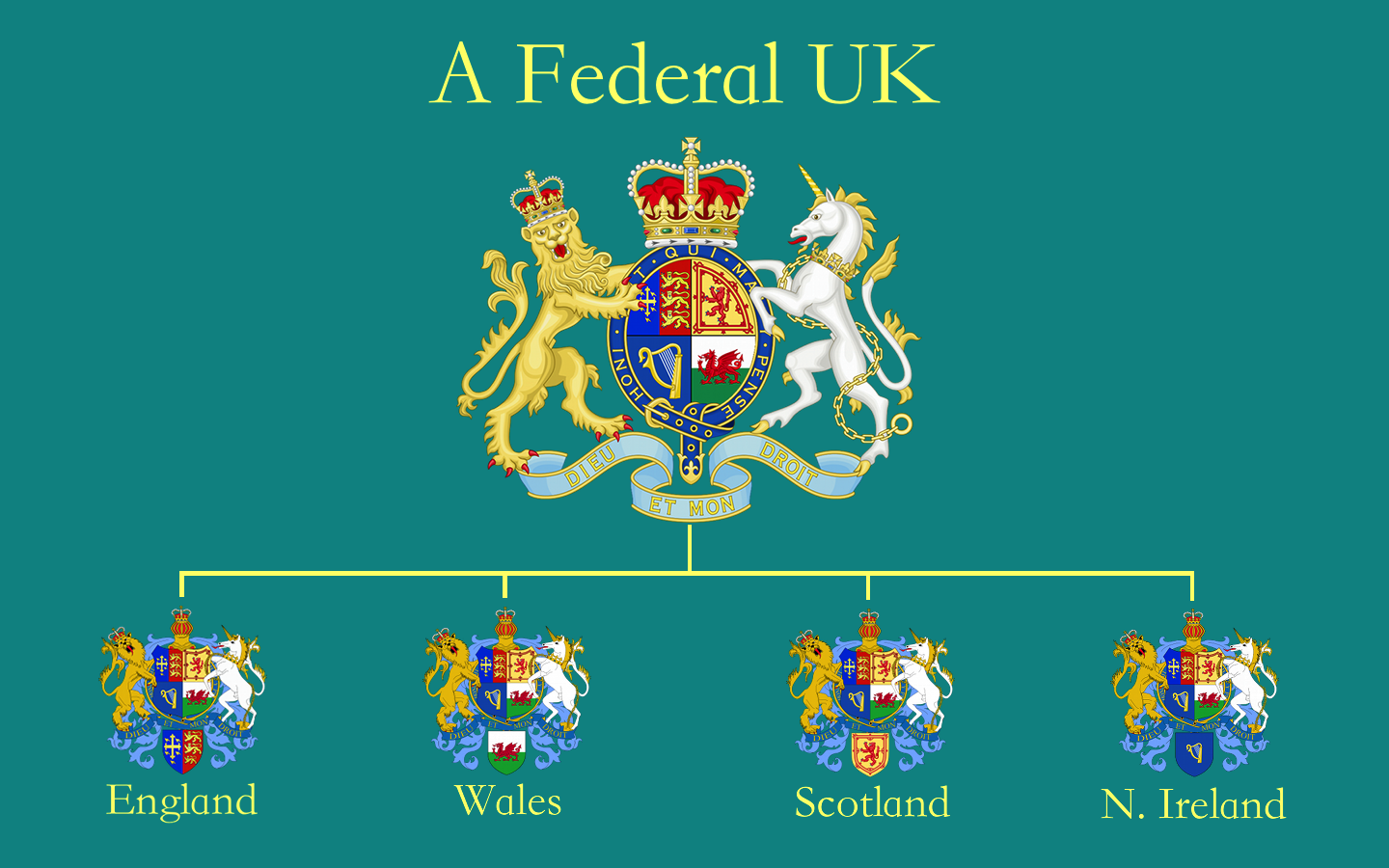
Below is a diagram that shows the basic structure of the proposed Federal UK.